Thursday, 2 August 2012

Week 1: IPSI Hague Symposium

Street Sculptures in Scheveningen

Greetings again from den Haag, in the Netherlands. I'm now a week into the IPSI Hague Symposium on Post-Conflict Transitions and International Justice. I'm also a week into being in Europe, which has been pretty nice. Here are a few highlights:

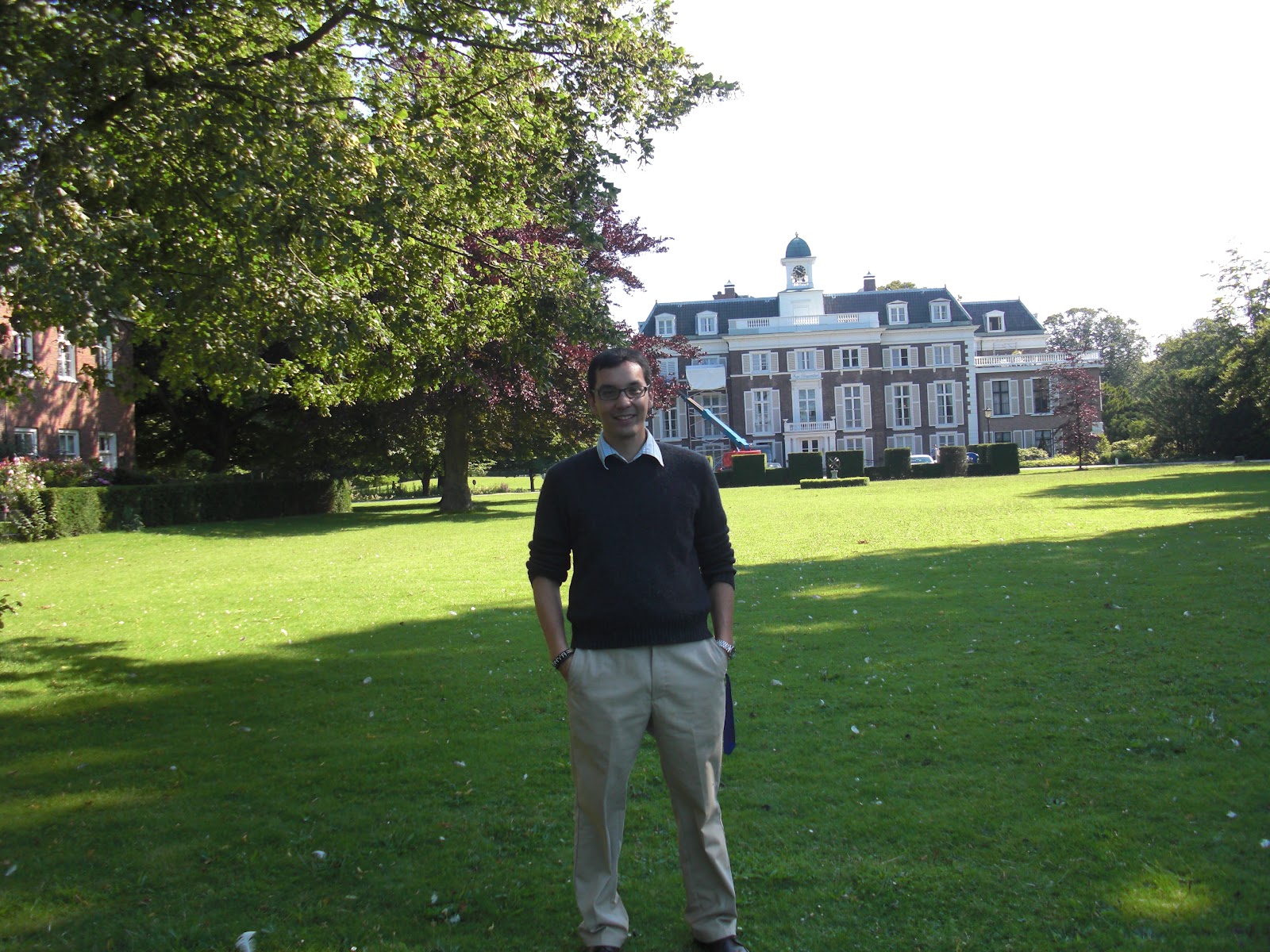
On the grounds in front of Clingendael
1. Clingendael - The symposium is held at a beautiful old building, which houses the Netherlands Institution for International Relations.


The building itself has a curious history. I can't remember the full details behind it, but the building was taken over by Nazis during the second world war, and occupied by such notables as Heinrich Himmler. One of the 'dignitary's' wives (was it Himmler's?) was (a) dog-crazy, and (b) completely ignorant of what was happening at Clingendael at the time. She made individual gravestones for each individual dog that she had, and buried them under a beautiful tree in the grounds behind the building.

Blind, Deaf, Genius Togo (the dog) , buried behind Clingendael
It's actually fairly strange, perhaps ironic, that these gravestones exist, given that Clingendael, at that time, was basically a interrogation and torture site. It's on this foundation that the Clingendael institute exists, as a learning institution dedicated to peace. That's a nice change.

It is located on a beautiful parks, and there are cows, sheep, and donkeys grazing around the fields. Ducks and swans swim in the ponds, and there is a small cafe that sells fantastic apple pie. An ideal learning centre.

 2. The Hague - The Hague (den Haag in Dutch) is truly the city of international justice. It houses the International Court of Justice, the Permanent International Court of Arbitration, the International Criminal Court, and the Special Tribunals for Sierra Leone, Lebanon, and Yugoslavia. For someone in my position, it's the centre of all things international justice. It's also a sleepy town, full of cute buildings, busy people riding bicycles all over the place, and a beautiful beach (in Scheveningen). I already know that I want to come back here.


3. The Conference - Of course, the reason I'm here is the conference, and it is not disappointing. I've had the pleasure of being lecture by academics, Lt. Generals at the UN, and, Special Representatives to the UN. Very high level discussions, and very insightful issues. This week was focused on the theoretical and conceptual backgrounds for transitioning states from conflict to peace and stability. In particular, we focused on Justice, Development, Security, and Governance issues - the four main pillars of a stable democracy.

Classes run from 8-5, monday to friday, with daily readings. If that is not full-on enough, I've volunteered to be part of a 'working group' on developing a 'Transitional Framework' - a blueprint for guiding states from conflict to peace and stability. A lofty goal - it's one thing that the organizers of the conference are very excited about, and I'm happy to be a part of it.

Otherwise, the group of participants have been wonderful. Coming from diverse backgrounds, it's created a very electric learning environment. I'm caught up in it, and the questions and discussions have been just as informative as the presentations themselves. I'm looking forward to how things are going to progress in the coming weeks!

In other news, I got an Op-Ed published in le Quotidien, a Senegalese newspaper! It was translated into French by an intern (Thanks Nastasia!), and is an update on the current situation on Kenya and the ICC. Check it out here.

That's all for now, check in next week!

The King and Queen of Scheveningen, slightly unimpressed 

Friday, 27 July 2012

Transitioning - Human Rights and Peacebuilding

This post is necessarily going to be 3 parts inspiration and 1 part ignorance, although that recipe is not scientific. Often, when I engage in the theory and concepts of the kinds of things I want to dedicate my life to, if often feels like I am 100% ignorant. That's not just a self-deprecating comment. I think it accurately reflects an important state of mind when engaging with ideas of conflict resolution, peace, security, justice, and development.

I'm currently in the first week of the Hague Symposium - a month-long training course offered by the International Peace and Security Institution on Post-conflict Transitions and International Justice. So far, we've had the pleasure of learning from ICC Prosecutor Bensouda, Professor Dov Jacobs, Lt. General Ton van Loon, and Jan Pronk, as well as various engaging discussions between the 60 participants, who come from 26 different countries. (if you want to read the IPSI blog on the symposium, check it out). The goal of the conference is to discuss, and hopefully create, workable solutions for ending conflict, establishing peace, and facilitating development. Lofty goals, but with a group of capable and motivated young intellectuals, it will be very interesting to see what turns out.

Approaching these kind of 'grand problems' does require a massive acknowledgement of my ignorance on large aspects of our global world. I hope this is a good place to start - many people that know much more than me, have worked hard at setting up the systems and dynamics that are currently in place in the world. And, to be frank, there are a lot more negative aspects to our current world order than positives. So perhaps a 'blank slate', or a beginners mind, are important aspects to tackling such a grand challenge. That's what I'm telling myself, at least.

Here are a few things that I've been thinking about, thanks to the lectures, as well as great discussions with peers:

  • Peace vs. Justice - there has been a lot of debate that in developing situations, especially where conflict is involved, pursuing peace is somehow incompatible with pursuing justice. I don't believe that this distinction works. Or, I believe that it only holds true if one considers the definition of 'peace' to be the cessation of hostilities, and the definition of 'justice' means prosecuting suspects in a court of law. Neither of those definitions hold true, and I am unaware of any particular situation in the world where the pursuit of justice has necessarily excluded the possibility of peace, and, vice versa, that the creation of peace between conflicting sides has stopped the process of justice. Definitely there have been situations where you can have one without the other, but that is not evidence that you cannot have one AND the other. That's just not true. But, I think that achieving a balance requires a radical redefinition of what 'peace' and 'justice' mean. A practical, realistic, and contextually driven definition.
  • Military Intervention - I've never really considered it before, but it really seems like any move towards building a peaceful society must involve the military. It almost seems paradoxical. As the Lt. Gen. mentioned in his talk - 'the military is trained in shooting people, and they're actually pretty good at it'. That seems to be a pretty weird foundation for peace. But failing to recognize the myriad possibilities and positive opportunities that military institutions can provide is short sighted. The military represents a physical manifestation of violence, but what else does it provide? More importantly, in any situation of conflict, some militarization will be present. So ignoring it is not an option.
  • Comprehensiveness - The idea that development requires a very broad range of services isn't very controversial. But, in reality, most development work is far from holistic. This is a grand challenge - how would we coordinate and cooperate (both at the domestic and international level) in a way that catalyses positive development - long term development, rather than short-term solutions that lead to further conflict and undesirable consequences. 
This is all pretty theoretical and conceptual. But, that is exactly the challenge, and that is exactly the most important thing, for me, that needs to happen. At the same time as I fill my brain with more concepts, more ideas, and more knowledge, I also need to preserve that 'mental blankness', so that I can have the creative space to turn the idea of peace into the reality of peace. The Dalai Lama's twitter feed just spouted this out: "Whatever you do, take a realistic approach and think of the long term interests of humanity". I wouldn't expect anything less than pure, timely wisdom from HHDL. It's a good aspiration, even if I'm not entirely sure what is 'realistic', nor what the long term interests of humanity might be. I'll do my best, and I hope you are too.

Thursday, 19 July 2012

OUT OF OFFICE: Autoresponse

Thanks for checking in. I'm currently in the Democratic Republic of the Congo, in Lubumbashi.
Lubumbashi, and its cobalt mine
I'll be back in Nairobi for about 10 hours, and will immediately be leaving for the Hague, in the Netherlands. I'll be attending this:  http://ipsinstitute.org/the-hague-2012/

I'll be updating my blog weekly, so stay tuned.

Tuesday, 10 July 2012

Intermission: Sore Feet

Post Race, Post Massage, Pre Sore Feet


On June 30, I ran a half marathon. It was a work-related function (team building!), and it was at the Lewa wildlife conservancy. OK, 'ran' is a bit of a misnomer. By some miracle of miracles, I finished the race. Now, my feet are sore, and I feel somehow entitled to complain to everyone (including the entire internet) about that fact.

No, I won't share with you my time. I will share that all manner of men and women (old and young, fat and skinny, white and black, etc) passed me. A 50+ year old woman with two knee braces on limped slowly past me. It was a humbling experience.

The ICJ Kenya Tent City at the Lewa Marathon.
--

In other news, I'll be heading to the Democratic Republic of the Congo next week. The DRC is a real hot spot right now (luckily not in the area that I'll be visiting), both because of the ongoing rebel activity, as well as the fact that Thomas Lubanga, the ICC's first convict, was just sentenced to 14 years imprisonment (minus the 6 he has already spent in ICC detention). I am trying to reconcile that sentence with 'normal' criminal law. It's interesting to compare the sentence someone would get in Canada for, say, manslaughter, with the sentence that Lubanga got for conscripting child soldiers. Some how it doesn't seem proportionate. But, it's a good lesson for the ICC prosecution team, though, whom the judges of the ICC took some time to heavily criticize.

Right after going to the DRC, I'll be heading to Leiden, in the Netherlands. I'm attending the Hague Symposium on Post-Conflict Transitions and International Justice. It's a 4-week long course, and I'm super stoked about it.

It's been fairly amazing, all this travelling, but there's one downside. I only have 6 pages left in my passport. Guess I'll just have to put my feet up, soon.

Twiga, Lewa Wildlife Conservancy

Thursday, 28 June 2012

Follow up: Cultural Sensitivity and fiddly bits.

Well, I had an interesting chat with some of my colleagues who took the time to read my blog. One person noted that it would be easy for a Kenyan, or probably any African, to find my comments on education insensitive or even offensive. On reading my post again, I can see why - saying that (a) there hasn't been significant institutions of higher learning in Africa until recently, and (b) that higher education is a mainstay for 'developed' countries is an indirect way of commenting on the 'primitiveness' of Africa. That is a very negative perception of African nations and African peoples. And it is not a perception I intend to feed into.

In fact, it is important to note that the idea of 'institutions of higher learning' are completely western conceptions as well - it takes certain subjects and professions as the 'yardstick' of societal progress. It does not, however, place any relevance or recognize the benefits of aspects of African culture that ARE well-developed and rich. And it does not recognize the kinds of institutions that are already present in the myriad cultures on this continent. It is the idea that, because a community/society does not have a 'courtroom', 'judges', or 'juries', that a legal system is not present. That would be historically false.

There has been positive developments on this issue. For example, the use of gacaca courts in Rwanda as a method of dealing with the huge number of cases surrounding the 1994 genocide was an example of using traditional dispute resolution mechanisms to obtain justice. But there will still be a disconnect, so long as people categorize institutions like gacaca courts as 'informal justice systems', which implies that they are on a lower tier of 'justice' that British or European systems. In Kenya, it is interesting to note that there are formal Khadi's Courts, which deal specifically with issues under Islamic Law (often to do with Marriage, Divorce, and succession issues). There is Constitutional recognition that Islamic Law is a separate legal system, and it makes room for that. This simultaneously creates an alternative legal stream for a class of people (muslims), as well as provides acknowledgement and recognition that Islamic Law is a 'legitimate' justice system.

I think that example applies to what I was saying about higher education in Africa - we can all agree that providing access to high quality education in Medicine, Engineering, and disciplines like that will benefit a society. What I didn't say, and should have said, is that we also need to recognize that providing higher education within a particular cultural framework is not only important, but necessary. There are no 'silver bullets' that will automatically fit for all African states. That's what I meant when I said that the 'solution' to the 'problem' of Africa will come from African people.

Give a woman a fish, and she'll eat for a day; teach her how to fish, and she'll eat for a lifetime; but if she goes ahead and builds a solar-powered organic free range chicken farm, don't force her to keep fishing.

--

In other news - the whole idea of 'primitiveness' had some interesting press in Kenya recently. Apparently, Korean Air created an advertisement for tourism in Kenya. They mentioned the safaris, the splendour, and they also said: "enjoy the...indigineous people full of primitive energy". Oops.

Well, Kenya has one of the fastest growing online cultures, and a favourite pastime of a lot of my friends and colleagues is using Twitter. #KenyansonTwitter, or #KOT is a highly active hashtag, full of banter, political discussions, and general Kenyan miscellanea.  Well, when they heard about this ad, they brought down the Big Stick of Twitter on Korean Air. If you search #primitiveenergy on Twitter, you will see thousands of comments and satires about this Korean Air gaffe. Some of them are hilarious. The avalanche of negative comments prompted Korean Air to pull the ad. In one day. Go Internet Solidarity!

--

Foreign Policy, in partnership with the Fund for Peace, have published the 2011 Failed States Index. I somewhat encourage you to check it out. But with a huge caveat - I think that it is absolute rubbish. Worse, it dramatizes some of the difficulties and crises around the world in an unforgivable way. See, for example, their 'Postcards from Hell' - yes, there are some areas of the world that are in dire straights, and yes, in some situations, people are enduring immense suffering. A picture may be worth 1,000 words, but it is irresponsible and mentally incompetent to think that a picture represents an entire country and its population. I can think of a few 'postcards from hell' from Canada that would portray Canadian life a little differently.

Maybe I need to read more deeply into the methodology, the factors and the overall impact of the study. Maybe the title 'failed state index' is just a bit of journalistic melodrama. Maybe. But the fact that Kenya ranks 16th on the list of the 60 'most failed' states, above places like Ethiopia (which just passed a law giving people a maximum 15 year prison sentence for using Skype, and jailed a reporter under its new anti-terrorism law), North Korea, Syria, and Israel/West Bank, makes me very dubious about the 'objectiveness' of this report. Under some of the factors contributing to its ranking, Kenya received an 8.9/10 (the higher the worse) under the heading 'Delegitimization of the State'. This being a year after passing a new Constitution, ongoing institutional reforms, and peace and stability since the 2008 post-election violence. Very interesting.

A failed state is a massive catastrophe - Somalia, #1 on the list, definitely exhibits many of the warning signs: unsupported centralized government, poverty, violence, mass movement of refugees, human-made catastrophes (famine), instability, poor economic development and major dependence on external interventions. Suggesting that Kenya is approaching a failed state status is a mystery to me. Areas of Kenya suffer from poverty and food insecurity. There is unrest in the areas near the Somalia border. There is corruption at many levels. But Kenya is the ICT leader in the region. It has a huge tourism industry. The new Constitution has led to many positive political and social developments. There is a long way to go, but I have to wonder: how did they get it so wrong?

Update: check out http://www.fundforpeace.org/global/ - Apparently the 2012 Index is out. Kenya is still 16th, which means that it scored WORSE, since South Sudan is now on the scene...

Tuesday, 26 June 2012

Perspectives: Education and Soccer


I was able to take a little break and go visit my sister in Germany with my fiancée this past week. It was a great trip, full of soccer, wine, trains, rich food, chocolate, and Germans (culture shock!). The internet was 'high speed', for real. It was also sad - my fiancée is heading back to Canada to start medical school. Well, that part isn't sad, I am super excited for her and her new career. I'm just not looking forward to being without my #1 sidekick/partner/fan.

Taking a break from Nairobi was also a good opportunity to take stock of what's going on, from a slightly removed perspective, in International Human Rights. With the Kenyan media in full swing and reporting on scandals, political manoeuvring, and the shockingly poor performance of the Kenyan National Soccer team, I was definitely getting some tunnel vision and a bit discouraged (and maybe even a bit cynical). In every lead up to elections in Kenya's recent history, there are certain things that seem to repeat themselves - tribal-based political activity, major scandals, and non-stop media dramatization. Well, this time, politicians have engaged organizations like GEMA and KAMATUSA to start the tribal discourse, the major scandal this time around centred on the National Health Insurance Fund, and the embezzlement of millions of dollars.

Some things don't need much dressing up, as the death of the Minister of Security, George Saitoti, and his assistant and aides was a major occurence. Saitoti was a presidential aspirant and a major political player since the Moi era. He died in a helicopter crash, the details of which are currently being investigated. Three days of mourning were declared, and there were constant memorials and photodiaries of his life and times. All the major political players eulogized his good deeds. No one seemed to mention the fact that he was a central figure in one of the largest scandals of grand corruption in Kenyan history - the Goldenberg Scandal, which to this day is unresolved. He seemed to get more tributes and mentions than Wangari Maathai, who passed away early last year, and who I consider to be a real (nobel-prize winning) hero.

So, I have been a bit sensitive to some of the negative occurrences leading up to the elections in Kenya.

But, being in Germany, with the associated culture shock and ultra-efficient city transportation, I was struck by a few things:

1. The first German University was established in 1386 (the University of Heidelberg). That's over 600 years old. That's 6 centuries of access to higher education for (some) German people.

After doing some extensive background research (i.e. Wikipedia), I found that the oldest university on the African continent is in Tunisia - the University of El-Zitouna, established in 737 CE*. The university teaches exclusively (so Wikipedia says) in areas of Theology, Islamic civilization, and Islamic law. As far as I could see, the next earliest universities popped up around the mid to late 1800s, and were almost exclusively through the efforts of colonialists. Significant African attendance at these universities didn't seem to occur until the post-world war II era (I think that the University of Makarere in Uganda is an exception).

What that means is that there are only one or two generations of indigenous peoples in Africa that have had any meaningful access to higher learning and education.

This is interesting. The influence of the 'developed world' on African Nations has been massive, for better or (usually) worse. I think, increasingly, that if there is going to be a 'solution' to the 'problem' of Africa, it is going to come through the practical and intellectual work of African peoples. Generally, all types of intellectual progress (science, philosophy, law, medicine, engineering, some of the arts, business, etc.) have their genesis in institutions of higher learning. And if the continent has only had meaningful access to this higher education for around 60 years, then I think large doses of empathy and patience are required, rather than the pity and pretentiousness that western culture takes towards African development. Of course, the concept of Universities and higher education is also a legacy of colonialism, but I think it is one that can have a positive impact.

This is pure speculation on my part, but I think it's a fascinating situation. It makes you wonder - if Africans are given the luxury of access higher education for 600 years, what kinds of things will develop out of that? It should also be noted that the types of developments through higher learning are also context dependent. For example, the reason that Kenya is a leading country in Africa in terms of Information and Communication Technology, is because it is an ICT hub, thanks to a direct cable running from India that provides Internet coverage. The reason that African nations like Kenya, Uganda, Rwanda, and South Africa have such expertise in International Criminal Justice (even though it is often unrecognised by developed states), is simply because of the amount of International Criminal Justice work coming out of African nations.

Similarly, the human rights abuses coming out of Africa (and everywhere else in the world), are at least partly due to the fact that human rights are such a new concept. England, France, and the USA have some of the oldest precursors to Human Rights documents, but our modern conception of human rights arose in 1948. Canada enacted the Charter of Human Rights and Freedoms in 1982 (it's the same age as I am). Kenya promulgated its new Constitution (with a Bill of Rights included) in 2010. It takes time to build a culture of human rights. Give Kenya 10 years, 100 years, and see how things develop under this new dispensation. The USA has had 200 years, and it is still doing a pretty poor job of protecting human rights.

2. I love soccer. Watching Euro 2012 games has been fantastic, and especially watching Germany play while in Germany was a nice touch.

I think that my appreciation for the game has progressed beyond individual skill, fancy plays, and goals, though. These days, I tend to watch soccer games as a sort of psychological exercise. I notice the fact that Spain still exhibit confidence with their 'tiki-taka' style, but that the weight of expectations has drained their precision and directness - they collectively seem to be more concerned about not making mistakes than destroying their opponents. The Portuguese have changed dramatically over the course of the tournament, and their last game shows that they are finally comfortable playing with each other - Cristiano Ronaldo's impact is a direct result of the team cohesion. The Germans are so coached up and cohesive that they have attained an almost zen-like emotional detachment from their game - they don't get rattled, they make extraordinary plays seem 'normal', and when Mario Gomez scores, they take it as an inevitability, rather than a celebration. I have no comment on the Italians, since I haven't figured them out - some of the players honestly look like they'd rather be somewhere else.

By far my favourite moment of the tournament came during the Spain-Ireland game. Ireland was out-gunned, out-classed, and, ultimately, outscored. But, the Irish never gave up, and played their hearts out right until the final whistle - you could see in the post-match interviews that the Irish players were discouraged and disappointed, but you wouldn't have known that while the game was on. That's the way that the game is supposed to be played. That's why it seemed like there were 50,000 Irish fans in the stadium, as they sang non-stop for the last 15 minutes of the game, with their team down 4-0. That's a lesson in what it means to be a 'supporter'. I wish more professional sports were played with that kind of attitude and in that kind of atmosphere.

Somewhere down the line, I will work on how soccer relates to Human Rights, and how it can save the world.
--
* I also found out that 'CE' is the new politically correct way to referring to dates - it is the 'Common Era', formerly known as 'AD' - so as to not upset non-Christians who also want to meaningfully talk about the past. Guess I'm behind the times on that.

Tuesday, 5 June 2012

Why Human Rights? And Where? Part II

After Lagos, from May 21-25 I was in Kigali, Rwanda. We were hosting a civil society workshop on the International Criminal Court, as well as organizing a judicial colloquium for the East African Magistrates and Judges Association. Arriving in Kigali was a complete culture shock. From Lagos, population of nearly 20 million people (Wikipedia says that the population is just under 8 million, but that is from 2006, and Lagos is the seventh fastest growing city in the world), to Kigali, population of less than 1 million.

Kigali is a beautiful city, nestled amongst the hilly terrain of Rwanda (the land of a thousand hills). Cars drive on the right-hand side of the road, at an acceptable speed, and even stop at traffic lights! That was pure bliss, after the chaos that is Lagos and Nairobi traffic. It's also an incredibly clean and well-kept city, with monthly 'clean up' days where people get together and clean up the entire city. Plus, plastic grocery bags are outlawed, which keeps a lot of litter to a minimum. I found it to be a pleasant and relaxing place.

In the background, though, one can understand why things are so orderly. There are armed guards and army officers every few hundred meters. We asked our cab driver to take 5 of us to our hotel, in his 4-seater car. He agreed, but was so nervous and anxious that he was literally praying the entire trip, in the hopes that the police or the army did not notice him breaking the law. There is a very real sense of militaristic order in Kigali, and while the Rwandan people that I met were all very soft-spoken and polite, there seemed to be an underlying sense of fear, as well.

This all makes sense in the context of Rwanda's history. You may have seen Hotel Rwanda, which was a good movie, but I had to opportunity to visit the Rwandan Genocide Memorial. In 100 days, from April-July 1994, nearly 1 million Rwandans were murdered. That was about 20% of the total population of Rwanda. There are better places to find out all of the facts of the Genocide (such as here), than my blog. The horrors of the genocide are still fresh, and although Rwanda has made significant strides in development since then, there is a real sense that making sure of 'never again' will take direct initiative by the government. Hence the presence of armed guards, and hence the presence of a very robust criminal law against genocide denial.

There are two things I wanted to mention about my experience at the memorial:

1. The scope and scale of the genocide is difficult to fathom. Killing that many people in that short a time frame is not easy to reconcile. I am a perennial optimist, and I believe the in kindness of strangers, but stories of neighbours, friends, and family turning against each other definitely shakes that belief. In fact, some of the stories, especially those of the murdered children, were saddening to some - one of the judges we went with was reduced to sobbing - but, for me, it was also infuriating. Dehumanizing someone to the point of murdering a defenceless child, let alone the rest of the men and women, is a psychological state that I cannot, on ANY level, understand. Thanks to the memorial, I now have a better understanding of what happened, and why certain events unfolded the way that they did, but I'm still left with the question: How could anyone do this?

2. The broader context of the genocide was a reminder about why I do the things I do. Colonial (Belgium especially) and Religious (Catholic) imperialism in Rwanda left an indelible mark on Rwandan society, culture and psychology. Then, after severely altering the make up of Rwandan society, they left the country to its own devices. After ethnic tensions started mounting, the United Nations started monitoring the situation. Then, when ethnic tension turned into ethnic cleansing, the United Nations pulled out its peacekeepers and the foreign (and local) dignitaries. The history of the Rwandan genocide, from an outsiders perspective, is a history of failure - a failure to understand a vibrant and rich culture, a failure to pay attention to conflict, a failure to effectively protect basic principles of human rights and democratic governance, a failure to mediate an ongoing dispute, and a failure to intervene in a massive scale violent crisis. Romeo Dallaire, the Canadian Lieutenant-General in charge of the UN Peacekeeping force in Rwanda estimated that a contingent of 5,000 UN troops could have controlled and stopped the violence. Instead, they used 5,000 troops to evacuate ex-pats, while the UN General Assembly issued a resolution 'strongly condemning' the violence in Rwanda.

Eventually, the RPF came, without major assistance from the international community, and ended the genocide and the civil war. And Paul Kagame remains in power to this day.

My recollection and understanding of the Rwandan genocide is limited. With ongoing trials at the International Criminal Tribunal for Rwanda, new facts and more detail have been shed on the situation. Even though there is much more to this story than I know, the history of the genocide is still incomplete. I am sure that there are more complexities and horrors that will come to light, and if I am being perfectly honest, I'm not sure I want to learn more about it. Kofi Annan said that the UN's failure with Rwanda leaves everyone with "a feeling of bitter regret". I would think that the feeling hits a little deeper than that.

However, I'm left with lingering thoughts from both the Kigali experience, and what happened in Lagos:

Human rights don't spur violence. Human rights don't promote ignorance, or hatred, or dogmatism. But what do human rights do? By all accounts, they've generally been concise lines of text on documents that haven't really been of much use in the world's history. But Human Rights, as we know them - as universal, morally correct, and profoundly beneficial - are young. The UN Declaration on Human Rights was conceived after the second world war, and is going on 64 years old. No major global ideology or system of belief has managed to capture the hearts and mind of a massive amount of the global community within the lifespan of one human being.

I believe in human rights. I believe in the principles they espouse. I believe that they apply everywhere, at all times, to all people. I believe that they will lead to a peaceful, healthy, vibrant human community on Earth. I also believe that human rights have no use if they are not promoted, protected, and accepted in the everyday psyche of individuals. That requires work - intellectual work, political advocacy, and on-the-ground everyday work. I believe I can do that work. I think I've started, and I'll keep it up, tomorrow, the next day, and we'll see how far that belief can go. So far, it's taken me to Kenya, Nigeria, and Rwanda. It's looking like it will also take me to Burundi, Uganda, Tanzania, and the Democratic Republic of the Congo. And judging from the news, I'm wondering if it will take me back home to Canada, too.

For me, Human Rights are a journey.

Wednesday, 30 May 2012

Why Human Rights? And Where? Part I

I recently had some opportunities that made me feel proud of the work that I do. At the same time they highlighted how gargantuan the task of 'protecting human rights' truly is. Humility is a staple at every meal, these days.

From May 16-20, I was in Lagos, Nigeria, for the African Network of Constitutional Lawyers Annual Conference. The theme for their conference this year was 'Nurturing Judicial Independence and Accountability in Africa'. I was asked to present a paper that I had submitted. Briefly, the paper was on the recent decision by the High Court of Kenya to issue an arrest warrant for Omar al-Bashir, the President of Sudan, should he enter Kenyan territory. If you'll recall, I blogged about it back in December, as the case was brought to court by ICJ Kenya. In particular, the paper I wrote focused on how the Bashir Decision was a good indication of the growing independence of the Kenyan Judiciary. It was a simple paper, and seemed well-received.

But this isn't a post for boasting. The conference was a forum for lawyers and legal academics to congregate from around the continent. There were lawyers from Cameroon, Nigeria, Chad, Ghana, Kenya, Zimbabwe, and South Africa. Brilliant minds from across Africa, all discussing major issues on the status of Judiciaries in Africa. The picture that was painted wasn't exactly glowing. Rampant corruption and underfunding of the judicial system in places like Nigeria have led to bizarre decisions where judges are acting as 'gatekeepers' for the political elite, sheltering them from responsibility and accountability. In Cameroon, the fact that judges have to 'answer' to the President is a serious violation of the independence of the Judiciary, and seems to have led to some serious miscarriages of justice. It highlighted some of the ongoing issues of corruption, impunity, and poor governance that continue to be a problem in Africa.

At the same time, it was a congregation of smart, passionate, and insightful individuals, who have dedicated their lives to bringing about a positive change. I once had the misfortune of hearing someone say that "the problem with Africa is Africans". I never really understood that sentiment - which Africans? All of the individuals I have had the pleasure of meeting have been hard-working, dedicated, and resourceful. Even those people living far below the poverty line have come up with innovative ways of making ends meet. Especially in the Human Rights field, many lawyers and activists toil tirelessly to fight against injustice and tyranny, putting their own lives at risk, for little or no material gain. So I wonder again - which Africans are causing the problems?

Lagos itself was quite an experience. The city is massive, with a population nearing 20 million people. I was staying on Victoria Island, which is apparently a more 'upper class' area. It was hard to tell one from the other, as Lagos is a crowded city - high rises next to low-income settlements, all cramped together as the city literally spills out into the sea. There is a shanty town built on stilts that is completely on the water. Despite the well-built roads, car transport is just as cramped - traffic is horrendous, dangerous, and loud. Nigerian people are just as loud and boisterous, but are incredibly friendly and jovial as well. It's obviously a vibrant country, despite the ongoing violence and tensions, and the people I met were fun-loving and really enjoyed watching me eat the local food. I was completely unprepared for Nigerian food, which was incredibly spicy, and rather exotic - including snails, among other things. Luckily, they also really like fried rice.

Wednesday, 9 May 2012

I grew up herding cattle, now I want to be an aeronautical engineer - Richard, 13

I'm feeling a bit inspired these days. This could from managing to finish a bunch of larger projects today; it could be because I was up until 4:00am finishing those projects. In any event, it has been an interesting and eventful month.

First, and probably most exciting, my parents came to visit me and my fiancée in April. I took some (much needed) leave days from work, and we went down to Arusha, Tanzania. Arusha is an interesting place. It is a small-ish city that has experienced somewhat of a boom in population and urban planning. This is for two reasons: (1) tourism - this makes the most sense, as Arusha is an ideal gateway to many fantastic safari opportunities (more on that later), and (2) because of the amount of human rights and international criminal justice initiatives that have centred there. The International Criminal Tribunal for Rwanda is located in Arusha, as is the African Court on Human and People's Rights. If I'm not mistaken, it's also the home of the East African Court of Justice. These institutions, especially the ICTR, has given Arusha a distinctly cosmopolitan flavour, mixed up nicely with a rural, traditional lifestyle.

I really enjoyed the atmosphere, since I'm distinctly pro-International Criminal Justice, and because of things like this:


And this:

I think we maximized the sight-seeing potentials in Northern Tanzania, visiting Tarangire Park, Lake Manyara, the Ngorongoro Crater, and the Serengeti. I generally tend to shy away from things that I consider to be 'too touristy', but going on game drives in this region truly is amazing. I think I can safely check that off my list, at least for sometime. There is something rather satisfying about having the patience to wait for a leopard to descend from its tree (while most other people have driven by, taken a few snaps, and moved on), pose, and then absolutely disappear into the grass. For some reason, it made me want to get back into rock climbing.

Game drives aside, though, the human rights field has been considerably buzzing. First, Thomas Lubanga was convicted for war crimes, largely for conscripting child soldiers. That is a massive win for international criminal justice, despite what some people think. And it is definitely more relevant than the Kony 2012 video that caused such a stir. Not only that, but on April 26th, the Special Court for Sierra Leone convicted Charles Taylor of 11 charges of crimes against humanity, war crimes, and serious violations of international humanitarian law. This is the first time a Head of State has been held accountable for his actions. In both cases, we are awaiting the decisions on how the two men will be sentenced (supposedly the prosecutors are looking for an 80-year sentence for Taylor).

This has been a busy month for International Criminal Justice. The decisions serve a clear warning to the political elite around the world that they will be held accountable for their actions (directly or indirectly). There has been some criticism levelled on the International Criminal Justice mechanisms, especially with regards to the amount of time and money that has been spent, with so few results. But I feel that most of these criticisms do not reflect a clear understanding of International Criminal Justice - even in domestic courts, criminal trials can take years to be resolved. And domestic cases generally revolve around one victim, and one event, in which the accused is directly linked. International Crimes exist on an entirely different paradigm, and have entirely different issues and characteristics. It is about prosecuting those most responsible for large-scale violations of human rights. It requires careful investigation (there will be no DNA evidence, no 'gun with fingerprints on it'), careful deliberations, and intensive legal work.

I have no doubt that the two verdicts will be appealed by the accused. Both the accused and the lawyers have too much invested in this process to simply let it stand. More importantly, because this is new ground that is being broken, in both cases, there is a substantial amount of legal principles and concepts of International Criminal Justice that are not yet universally agreed upon. So that leaves a large chunk of lawyerly work left to do. But, even if they appeal, more legal consideration is only a positive thing. One of the most important aspects of trial procedure is that the decision serves as an historical reference point for International Criminal Justice, and one that will be used to guide further progress, both with its successes and failures.

I was also fortunate to attend a TED event in Nairobi. This event was called 'TEDsalon', and was part of a worldwide talent search that is being undertaken by the people at TED, in order to find young and brilliant talent.


I say fortunate because (a) there had been minimal advertising for the event, which was crazy, since it was free, and TED is rather a global phenomenon now, so we were lucky to find out about it, and (b) because it is now the rainy season here, traffic is generally crazy, and was worse today because of all the accidents. We squeezed into the doors, just as they were closing, and got our minds blown, along with the other 500 or so people packed into the small auditorium.

The topics ranged from wildlife conservation to alternative fuel sources to slam poetry to journalism, and everything in between. The format of TEDsalon was for each participant to inspire the crowd in 6 minutes. We were instructed to give standing ovations, or boo, as individuals, and try and be active participants in the process. The facilitators who had given us these instructions were not from around here, or at least were used to British crowds, because I don't think they were prepared for the Nairobi crowd. We were raucous, loud, and incredibly supportive - I feel like every speaker probably felt pretty good about themselves. Here are some of my favourite moments:

  • Richard, a 12 year old boy, invented a system, using a car battery, a signal switch from a motorbike, and LED lights, to scare off lions from the cattle that he was responsible for herding and protecting. Simultaneously, he protected his father's wealth, and contributed to lion conservation - lion populations have been rapidly declining as human settlements creep closer and closer to lion territory. Thanks to that invention, which is being implemented in many different communities, Richard has secured a full scholarship to the country's best high school. Now he wants to be an air plane engineer.
  • A man walks on the stage, wearing a ski mask, and a baseball hat with beads hanging down, so we can't see his eyes. He is an undercover journalist, who has dedicated himself to 'naming, shaming, and jailing' those people that take advantage of the vulnerable. He works with Al Jazeera, and uncovered some of the most disturbing evidence of the treatment of Albinos in Tanzania, and Psychiatric Patients in Ghana. In each case, he goes 'undercover', assuming an identity (such as a psychiatric patient), so that he can gain access to situations most journalists and prosecutors are unable to. He builds a story, builds evidence, and literally takes down the bad guys.
  • A 19 year old girl comes on stage, and delivers probably the best piece of poetry I've ever heard live. It's called 'Call me Africa'. It speaks of prejudice, independence, misconceptions and spirit. But the most engaging thing was the response from the crowd, who was seemingly living and breathing with the whole thing. Immersive, and a little spine-tingling.
  • There was a lot of talk about toilets. We tend to take our waste for granted. We flush it down the toilet. But in Kibera, Nairobi's largest slum (and indeed, in all the informal settlements in Nairobi, which house 2/3rds of Nairobi's population), where does that waste go? Well, as a few people recognized, it doesn't go anywhere (because of a lack of sewage and piping), and worse, it goes to waste. Instead, some people have taken the notion that 'Human Investment' (or 'shit', as one of the presenters was quick to point out) is now being used in these areas as a viable source of fuel. There are now several 'bio-centres' in Kibera that, on one end, are public toilets, and on the other end, fuel gas stoves for kitchens and cafeterias. Although, as one presenter pointed out, more work has to be done to involve the individuals, especially when it comes to preserving human dignity. After all, 'who wants to cook in a toilet?'
The whole event was a bit awe-inspiring. It was a great reminder of resourcefulness of human nature, and a reminder that there is a very different story behind the 'malnourished, dangerous, crushed by poverty' Africa.

I'll end there, but expect more updates soon - I am going to Nigeria next week, to present a paper at the African Network of Constitutional Lawyers. It will be good, epic, or both.

Saturday, 7 April 2012

Changes abound


Well, my tenure as a CBA intern is officially over.  My final report was submitted, all the boxes on the list were checked, and I've emailed my farewells.

But the adventure isn't over!

My new position with ICJ Kenya has started. I am now the Assistant Programme Officer in the International Cooperation Programme (or, ICP).  The ICP is focused on the East African International Criminal Justice Initiative, a large, multi-year project funded by the European Union, which seeks to promote, domesticate and implement the Rome Statute of the International Criminal Court within the East African region. So far, the project focuses on 7 countries - Kenya, Tanzania, Uganda, the Sudan (both, now), Rwanda, Burundi, and the Democratic Republic of the Congo.  It's a large undertaking, and its ultimate aim is the end of impunity, so it is very exciting for me. It also gives me some opportunities to travel around the region, and be engaged in places I otherwise wouldn't have seen.

The new position will also see a shift in my work focus.  As an intern, I was part of the Human Rights Protection team in theory, but in practice I was a jack-of-all-trades, and worked with every group at ICJ Kenya. Now, I will be focused on one program, and the various projects in administers.  Project management is a key aspect of my job description, and as I found out at our recent Planning Meeting in Mombasa, this also involves event planning and budget administration.  I also learned that when you tell people that there is a "limited travel allowance for participants", people will hear "take taxis everywhere, especially when you want to go out drinking".  So, a bit of learning needed on my part.

Other changes to report:

  • My shoes:  I have one pair of black shoes and one pair of brown shoes (with matching belts). As a by-product of walking to work everyday, my dress shoes have gotten scuffed.  This is a big deal - my Kenyan colleagues dress smartly, so they didn't hesitate to point out the fact that my shoes looked terrible, and that I was being a 'typical mzungu' (since most travellers tend to bring their 'bad' clothes to Kenya, maybe because of some misconception that they might 'fit in' a bit better).  So, I asked a colleague to take my brown shoes in for a polish.  Imagine my surprise when they returned, shining, and jet-black. I'm not entirely sure how this got lost in translation, or perhaps the shoe polisher only had one colour, but now I have two pairs of black dress shoes.  I suppose I'll have to go shoe-shopping, now, since I have no reason to wear my brown belt anymore...
  • My routine: After my spectacular failure to run in the Masai Mara marathon (for that story, and the dead donkey, read here), my goals to run a half-marathon in Kenya fell off the rails. Call it post-donkey complacency disorder. Now, I am back on track, thanks in part to my fiancée, who is a great motivator, and to the impending race that I am duty-bound to participate in: the Lewa Marathon.  This is an annual event at work, and apparently is one of the hardest marathons in the world.  This might have something to do with the fact that they have to chase wildlife away from the race route. Either way, I've taken to getting up at 6am, to go run around the dusty streets of Nairobi. Who knew?
  • My hair:  I cut it short. One coworker (female), got mad at me for not saving the hair, because she would have liked to have made a wig out of it. I'm not sure what else to say about that.
Otherwise, major changes continue to linger on the horizon of the Kenyan landscape - Oil was discovered in Turkana County (Northern Kenya), election campaigning is becoming paramount, and intermittent grenade attacks are all over the news these days. It looks like the Kenyan elections will happen in March 2013, so this promises to be a very interesting year.